BOTWAY / WHITE PAPER
Botway: Artificial Intelligence and the Reorganization of Real Estate Brokerage
Why software can now do the work of a brokerage, and how Botway is built to do it
Abstract
Real estate brokerage bundles market knowledge, marketing, paperwork, negotiation and the coordination of every step of a deal into one relationship. Americans pay roughly $100 billion a year for it in commissions [1]. When I analyzed six years of my own sent email, coordination far outweighed negotiation. Most of what a brokerage does is the work of moving a deal from one step to the next.
Artificial intelligence now does that work. It makes each task faster, and it can carry a whole sequence of tasks to a finished result: an answered renter, a signed lease, a closed sale. Software that produces the outcome can replace the service that used to produce it. Nothing protects brokerage from that if the experience is better and the cost is lower. Most of the industry uses AI to make agents faster while keeping the full fee. We use it to lower the cost for everyone.
Botway is a licensed brokerage in New York and Connecticut built for this new reality. We give owners free listings and free property management software. We keep a record of every property, who owns it and its history. We market every listing ourselves and run each lease or sale as a competition toward the owner's goal. AI handles the conversations, the documents and the steps of each deal, under clear rules about what it may do on its own. And we keep every client's full context, every recommendation, decision and result, so each deal is run better than the last and better than a person working from memory could run it.
This paper makes four claims. Software lets one team serve far more clients. Free tools turn a one-time deal into a relationship that lasts as long as the owner holds the property. Each part of the business makes the others better. And the system improves with every deal. The paper separates what we have built from what we still need to build and test before a complete transaction, and a property's management, can run on software from start to finish. In the end our clients will judge it, by whether they choose to use us.
1. Introduction
Suppose you were founding a real estate brokerage today, knowing that software will soon be able to do most of the work. It will research the property, read the market, produce the marketing, answer every inquiry, schedule showings, compare offers, prepare the documents and run each deal from start to finish. How would you build it?
For me that question is practical. I have been a broker for sixteen years and have completed 2,789 transactions across five states and four New York City boroughs, from single apartments to new-construction lease-ups and investment sales. The problems that led me to build Botway are familiar to anyone in this business. An inquiry arrives on a Sunday night and waits until Monday. An owner has to call to learn how many people toured. A showing depends on someone finding a key. The terms of a deal are scattered across texts, emails and portals. A listing gets full attention in its first week and less in its third, because newer listings arrive and a broker's day does not get longer.
Good brokers solve these problems through persistence. But a broker's day has a fixed number of hours, so a brokerage that wants more clients has to hire more people. I wanted something different. I wanted a large company with many clients who had hired us, without the number of clients being limited by the number of people who could personally attend to them.
The market is large enough to make the question matter. Americans bought 4.06 million existing homes in 2024, the fewest since 1995 [2], and the National Association of Realtors counted 1,453,690 members in May 2025 [3]. Every rental lease adds to that volume, and nearly all of it still moves through the same manual process.
So this paper asks one question. What does a brokerage look like when finding, understanding and coordinating information costs about as much as running software?
My answer rests on four claims.
Claim 1: one team can serve far more clients. When software handles the routine work of a deal, the human minutes needed for each completed transaction, counting routine work, problems and oversight, fall sharply. The number of clients we can serve can then grow much faster than our staff.
Claim 2: the relationship outlasts the deal. Free listings and free property management software keep an owner working with us between transactions. When the next vacancy or sale comes, we already know the owner and the property, and winning that work costs far less.
Claim 3: each part makes the others better. Finding owners, knowing their properties, marketing and selling their listings, and running their deals each work better inside one company that shares the same information.
Claim 4: the system improves with every deal. We record every recommendation, every decision and every result. When a person steps in to correct something, that correction shows us what to fix, so the next deal needs less help.
The evidence comes from three places: my own practice, through 19,354 of my sent emails and a record of 244 of my transactions described in section 2.1, Botway's software as built, described in the present tense, and published research, which is cited. Where I describe what scale could look like, I say so and name how we will measure it.
2. How brokerage works today
2.1 What my email shows
Owners generally believe they pay a broker for pricing, marketing and negotiation. My own correspondence tells a fuller story.
Data and method. The data is my sent email from 2020 to 2025. Of 24,820 messages recovered, we removed 1,885 duplicates, 3,574 messages too short to classify and 7 automated messages, leaving 19,354. A language model gave each message one label for its situation and one for its recipient, from fixed lists. A message that mixes logistics and negotiation therefore gets only one label, and the labels have not yet been checked against a sample coded by hand. The transaction record comes from the threads with the most deal content among 1,409 substantive threads. A language model summarized 244 distinct transactions, named the main source of friction in each and wrote down the lesson. Those records are also unchecked and are not a random sample. Both analyses show how often subjects come up in my email. Neither measures how much time each one took, and both describe one broker's practice, so they illustrate the problem rather than measure the industry.
| Situation | Emails | Share |
|---|---|---|
| General updates and questions | 5,413 | 28.0% |
| Lease execution: terms, signatures, move-in | 5,210 | 26.9% |
| Brief confirmations | 2,635 | 13.6% |
| Applications and documents | 2,349 | 12.1% |
| Showings and access | 1,608 | 8.3% |
| Deposits, fees and payments | 767 | 4.0% |
| Negotiation | 703 | 3.6% |
| Conflict or bad news | 367 | 1.9% |
| New business | 302 | 1.6% |
Figure 1. What six years of my brokerage email was about. Botway's analysis of 19,354 sent emails, 2020 to 2025, labeled by a language model. The median email was 29 words long.
Coordination dominates. Negotiation was 3.6% of my messages. Lease execution, applications and showings together were nearly half. These are counts, not hours. A short negotiation email may follow an hour on the phone, twenty confirmations may take minutes, and some judgment happens inside messages labeled as updates. Even read narrowly, the pattern shows a large and constant operational load, carried by short messages that each move a deal one step forward.
The transaction record points the same way. Of the 244, price and terms were the main source of friction in 68, and timing, logistics and access in 67. The rest involved deposits and payments, lease signatures, co-op and condo boards, financing and guarantors. In roughly three of four, the hardest part was not the price.
The lessons read like a manual for coordination. Track the landlord's countersignature separately from the tenant's, because a fully signed tenant can still stall on the landlord's side. Have certified-check instructions ready when a payment portal fails before move-in. Check an applicant's email address against any bounce, because one typo can silently stall a signed deal. A well-built system does each of these every time. A busy person does them most of the time.
2.2 Why brokerages exist
Ronald Coase explained why firms exist. Using the market has costs, such as finding the other party, negotiating and enforcing the deal, and work moves inside a firm when doing it there is cheaper [4]. A brokerage is exactly that kind of firm. It saves the owner the cost of finding a buyer or tenant, agreeing terms and getting the deal done.
What makes brokerage distinctive is how it delivers those savings: by doing the work with people. The broker searches, matches, reminds and reconciles. Three consequences follow.
First, the relationship comes and goes. An owner may sell once a decade and lease a unit every year or two. Between deals the relationship usually lapses, and each new deal starts by rebuilding facts the brokerage once knew.
Second, the knowledge lives in people. Much of what a good broker knows is tacit, in Michael Polanyi's sense: easier to do than to write down [5]. It sits in the broker's judgment and inbox. When a broker leaves, much of the firm's experience leaves too.
Third, growth means hiring. Each deal takes a person's attention, so a brokerage's capacity rises roughly in step with its headcount.
2.3 Why the cost stays high
Economists have documented how commission pricing interacts with this. Chang-Tai Hsieh and Enrico Moretti showed that because commissions are a percentage of price, the fee rises with house prices even though the work barely changes. In cities where land got more expensive, more people became brokers, the average agent sold less per hour worked, and agents' real wages stayed about the same [6]. Higher fees paid for more people doing the same work, not for better service.
William Baumol explained why that doesn't correct itself. Where people are the product, productivity grows slowly, so the service keeps getting more expensive relative to everything else [7].
There is also an incentive gap. Steven Levitt and Chad Syverson compared homes agents sold for clients with homes they sold for themselves. Agents' own homes stayed on the market about 9.5 days longer and sold for about 3.7% more [8]. That isn't bad faith. An agent who keeps a small share of a higher price, and pays for the extra weeks in their own time, faces a different calculation than the owner who keeps nearly all of it.
And there is an information gap of the kind George Akerlof described [9]. The broker knows how many people toured, what they said and how the offers really compare. The owner gets a weekly summary. For most of the industry's history, controlling that information was part of the broker's value.
2.4 Why technology hasn't fixed it
Real estate has absorbed plenty of technology without changing this structure. Listing portals made homes searchable but did not answer inquiries. Property management and contact software turned files into databases but left people to send, chase and reconcile.
The attempts to change the business model each attacked one side of the problem. Discount brokers cut the fee but kept the same human process, so a lower price meant thinner service or more clients per agent. iBuyers tried to replace the hardest judgment, the price, with their own money. Zillow closed its home-buying business in November 2021, saying home prices had proved harder to forecast than it expected, wrote down its inventory and cut about a quarter of its staff [10]. One approach automated the records. The other bet the company on the price. The coordination in between, where most of the work lives, stayed manual.
3. Why AI changes this now
Richard and Daniel Susskind argued that the professions exist to make expert knowledge available to people who don't have it, and that technology would increasingly deliver that knowledge in new ways [11]. For brokerage, that moment has arrived.
AI makes every individual task faster: reading a document, writing a reply, comparing terms. More important, it can now carry a sequence of tasks to a finished result. For decades business software was a record of what people did. Now it can read a conversation, pull the terms out of a document, see what's missing, choose the next step, use other tools and check the result. Foundation Capital calls this "service as software," where the company sells the outcome itself and is responsible for it [12]. Menlo Ventures describes AI built for specific industries as software that competes for money that used to go to people and services [13]. Software that delivers the outcome can replace the service that used to deliver it. Brokerage has no special protection from that if the software gives clients a better experience at a lower price.
Anthropic distinguishes two ways to build such systems [14]. Workflows follow a fixed path and suit steps whose order is known, like the chain from an approved application to a signed lease. Agents decide for themselves which tools to use and suit open-ended work, like answering a renter's unexpected question or reading an offer in an unfamiliar format. A brokerage needs both, combined so that open-ended reasoning always operates inside fixed rules about what may be done.
Three changes make this practical now.
The first is cost. Stanford's AI Index reports that the cost of running a model at GPT-3.5's level fell more than 280-fold between November 2022 and October 2024 [15], and Andreessen Horowitz estimates that for the same capability the cost falls about tenfold each year [16]. Work that was too expensive to automate across every message of every deal is now cheap.
The second is capability. METR found that the length of task leading AI systems can complete half the time, measured by how long it takes a skilled person, has doubled about every seven months for six years [17]. Its tests are mostly software and reasoning tasks, not brokerage, so it shows the general trend rather than a measurement in real estate. Evidence from real workplaces points the same way. In a study of more than 5,000 customer support agents, Erik Brynjolfsson, Danielle Li and Lindsey Raymond found that AI assistance raised productivity about 15% on average, with the biggest gains for the least experienced workers [18]. The tool spread the habits of the best workers to everyone else, which is exactly what a system built on an experienced broker's practice is meant to do. In leasing, ShowMojo and Tenant Turner reported that 98.1% of renter conversations handled by their AI ended without the renter asking for a person [19].
The third is regulation. Since August 17th, 2024, offers of pay to buyers' agents can't be published on the MLS, and buyers' agents need a written agreement before touring [20]. In New York City, the FARE Act took effect on June 11th, 2025, so whoever hires the broker now pays the broker [21]. Fees are more visible and more negotiable than ever.
People still want help. In the National Association of Realtors' 2025 survey, 91% of sellers used an agent and only 5% sold on their own, the lowest share on record [22]. Demand for what brokers deliver isn't going away. What is changing is who, or what, delivers it, and at what cost.
4. Why Botway
Everyone in real estate can use AI now. In NAR's 2025 technology survey, 68% of Realtors said they use AI in their business, and 46% use AI-generated content such as listing descriptions [23]. Intelligence has been democratized. It is no longer expensive to think.
My thesis is simple. AI can do the thinking work I do as a broker, better and instantly. It can read a lease, price a home, answer a renter at midnight, compare five offers on what the owner actually nets and track every step of a deal without forgetting one. And it costs far less for software to think than for a person to think, a cost that keeps falling every year [15] [16].
What matters is what a firm does with that. Most of the industry is using AI to make agents faster while keeping the full fee. The work gets cheaper to do, and the client pays the same. RealTrends found that the average agent commission was 2.65% before the settlement's rule changes took hold and 2.71% after [24]. Fees haven't fallen. Botway is the only firm in the market doing the opposite. We use frontier AI models to make real estate transactions less expensive, and we pass that saving to the people we serve. When the work is automated, the price should fall with it.
That puts Botway at an unusual intersection of intelligence, data, process and outcome. The intelligence comes from the best AI models available. The data comes from our record of every property and owner and the history of every deal. The process comes from sixteen years of brokerage turned into rules the system follows. The outcome comes from a licensed brokerage that can act on a request: list the home, show it, take the offers and close. You can ask Botway to do something and actually get an outcome. Any one of these pieces can be bought or copied. Together they let us give the software away and charge a fraction of a traditional fee.
Making real estate less expensive for everyone is our goal. It's our motto, our mission, and the inspiration for the company.
5. The Botway business model
5.1 What we offer
Any owner can list a rental or a sale with us for free. We publish it on the MLS, our partner sites and Botway's own search, and send the inquiries straight to the owner. Any landlord can run their properties on our property management software for free, with no limit on units and no contract. Owners who aren't leasing or selling can use Owner Home, which tracks a property's value, taxes, insurance and records, with tools for questions like what a sale would net or whether to sell or rent.
When an owner wants us to do the deal, we charge a flat $1,000 to lease and 1% to sell, with a $5,000 minimum, paid at closing. Housing voucher holders get full-service representation from us at no cost.
5.2 Property management built in
Brokerage and property management have always been separate businesses on separate software. A leasing broker fills a vacancy and hands the tenant to a manager whose system the broker never sees. The manager's records, the rent history, the repair log and the lease dates, are exactly what the broker needs at the next vacancy or sale, and they sit in someone else's database.
We build property management into the brokerage and give it away. Rent charges post every month, prorated to the day. Landlords record payments from their own bank or payment app and the books update, and we never hold the money. Late fees post once, within New York and Connecticut limits. Residents report repairs through a private link with photos. Vendors quote, schedule and invoice through one link per job, and jobs under the owner's approval limit go ahead while bigger ones wait for the owner. Signed leases and vendor invoices are read automatically, with every term tied to its page. The books are double-entry, with bank reconciliation, a month-end close and owner statements, and they export to QuickBooks and Xero. Owners can take all of their data with them any time.
Moving to Botway costs nothing. Buildium accounts connect directly, and every other system, including Yardi and AppFolio, comes in through its standard rent roll, balance and deposit exports. We check the columns and the totals with the owner before anything goes live. The most an owner does is pull those exports. There is no contract, and an owner can take everything with them whenever they want.
That matters for the brokerage in two ways. When a lease nears its end, we already know the unit, the rent, the tenant's payment history and the condition of the apartment, so a renewal or a new listing starts with the facts in place. And because management is where owners spend most of their time with a property, it is the strongest version of the lasting relationship in Claim 2. We earn nothing on the software. We earn when the owner leases or sells.
5.3 Why free
High fees have held real estate services in a chokehold for decades. Selling a home has commonly cost several percent of its price. Leasing an apartment has often cost a month's rent. A small landlord pays every month for software just to keep the books. Those fees buy the time of licensed professionals, and the bar to become one is low. In New York a salesperson license requires being 18, completing a 77-hour course, passing a multiple-choice exam with an hour and a half to finish it, and finding a sponsoring broker [25]. In Connecticut it requires a 60-hour course and an exam [26]. Many agents are excellent. The license doesn't require it. Owners have paid professional prices for work that is mostly coordination, done by people with a few weeks of training.
Free changes who gets served. When software does the work, the cost of serving one more owner is mostly computing and data, so the tools can go to everyone: the owner of one apartment and the owner of three hundred, the first-time seller and the voucher holder. Competing property management software starts at $62 a month at Buildium and $199 at DoorLoop [27] [28]. Ours costs nothing.
Free also builds the company, in three ways. Owners start using us and keep using us between deals, through turnovers, renewals, tax assessments, insurance and eventually a sale. When the next vacancy or sale comes, we already know the owner and the property, so winning that work costs far less. And every listing brings renters and buyers, whose demand makes listing with Botway more valuable to the next owner. Jean-Charles Rochet and Jean Tirole showed why platforms that serve two groups often charge one of them nothing: its participation creates value for the other [29]. We charge only when an owner hires us to lease or sell, because that is where the value is realized.
6. Knowing every property, marketing it, showing it and selling it
6.1 A record of every property and who owns it
We keep our own record of properties and their owners. In New York City we read deeds, mortgages and mortgage payoffs from ACRIS, the city's public property register [30], and building registrations from the Department of Housing Preservation and Development. We match a condo unit to its own tax lot, which a street address hides, check whether a mortgage has been paid off, and keep the legal owner separate from whoever logs in. Every assignment then sits in its full context: the building, the company that holds title, the other properties that company owns and the history of sales and loans.
6.2 Reading the market
We price from public sales and rental data and neighborhood market statistics. Our own finished listings tell us something different: how many inquiries, tours and applications a healthy listing of a given type, in a given neighborhood, gets in its first 14 days, adjusted for how fast the market is moving now.
Every 14 days we review each listing against the owner's goal, which includes a target price, a deadline and, if they choose to tell us, their lowest acceptable price. When the evidence says the price is wrong, we recommend a specific figure. We also catch problems that aren't about price. Lots of inquiries with few tours points to the presentation or access. Lots of applicants who don't qualify points to the criteria or the audience.
6.3 Marketing
Marketing is how a listing reaches the market, and it starts with the assets. Great photographs, an accurate and specific description, and a story that lets someone picture their life in the home do more than any placement. Studio, our creative system, turns an owner's photos and answers into listing copy, video and ads built around that story. Every listing then goes to the MLS, our partner sites and Botway's own search. Studio is also built to buy ad space, run controlled tests and credit each tour, application and offer to the idea and channel that produced it. Most brokerages rent their buyers and renters from listing portals. We are building our own. All of it is aimed at the owner's goal: the price and the date they set.
6.4 Showing: why self-guided tours are the best way to see a home
The traditional showing puts a broker's calendar between a buyer and the home. Someone finds a listing on a Tuesday night, asks to see it and waits for a time that suits the agent. A self-guided tour removes that wait. The visitor books a time, verifies their identity and lets themselves in. I believe it is the best way to show, see and sell real estate, for six reasons.
It meets interest when interest exists. People look at homes after work and on weekends, when brokers are least available. The Preiss Company reported that 59% of the self-guided tours scheduled at its properties fell outside nine-to-five hours and 46% fell on weekends [31]. Hemlane, a rental management platform, analyzed 15,772 tour attendees across 2,762 units and found that most self-guided tours took place on weekends or outside business hours [32]. A showing schedule built around an agent's day turns that interest away.
More people see the home. In Hemlane's data, self-guided units drew a median of five showings each, against two for tours led by a person [32]. More showings mean more applications and offers to choose from, which is what the competition described in the next section needs. The same data found that self-guided units leased in a median of 18 days, against 16 for person-led units [32]. That is essentially the same speed, achieved without an agent spending an hour at every door.
People decide with their hearts, and they need room to do it. A visitor alone in an apartment moves at their own pace, opens the closets, stands at the window and pictures their life there. With an agent at their elbow, they tour on the agent's clock and hear the agent's pitch. In my experience the decision happens in those unhurried minutes. Questions still get answered at once, because Botway answers them by text and email during and after the tour. And every visitor is asked afterward what they thought, so the owner hears from every visitor rather than reading an agent's summary.
Everyone gets the same access. The person at the door has long been one of the places where discrimination happens. Newsday's three-year investigation of Long Island brokerages sent paired testers with similar finances to the same agents. Black testers were treated unequally 49% of the time, Hispanic testers 39% and Asian testers 19% [33]. New York's Attorney General opened an investigation, citing reports that minority testers were steered toward different neighborhoods and held to stricter conditions, such as a mortgage preapproval before they could see a home [34]. A self-guided tour applies one set of written requirements to every visitor. No one at the door decides who gets in, which home they see or what they are told about the neighborhood. It doesn't remove every form of discrimination, but it removes the one where the evidence is strongest.
It is safe, and it proves the listing is real. Each visitor's identity is verified before the tour, entry works only during the booked appointment, and a building's access path is tested from the street door to the unit before self-guided tours are allowed at all. Botway has integrated with clients' own building security systems to provide that verified entry. The tour also protects renters from fraud. The Federal Trade Commission warns that fake landlords usually invent an excuse not to show the property [35]. A tour arranged through the owner's brokerage and the building's own access system shows that the listing is real.
It is proven, and it leaves the buyer free. Self-guided touring is no longer an experiment. SmartRent reported its one-millionth self-guided tour in October 2024, and a Morning Consult survey it commissioned found about 70% of millennial and Gen Z renters interested in touring on their own [36]. block.a has run self-guided tours and online leasing for property managers nationwide since 2020 [37]. I ran self-guided tours myself as a full-fee broker, more than 1,000 of them without a single incident. For buyers there is one more advantage. Since the NAR settlement, a buyer's agent must have a written agreement with a buyer before touring a home with them [20]. An agent who opens a home only on the seller's behalf, as at an open house, needs no such agreement [38]. A self-guided tour of a listing works the same way, so a buyer can see the home before deciding whether to hire anyone.
The strongest objection is that many people still want a person. In the 2024 NMHC and Grace Hill renter survey, 71% of renters wanted an in-person tour with a representative and 38% wanted a self-guided one [39]. The answer is not to choose. Self-guided is the default, so nobody waits on an agent's calendar, and a person is there for anyone who asks. Some showings need a person every time: a unit with a tenant living in it, a co-op whose board requires an escort, a buyer about to make the largest purchase of their life who wants to walk through it with someone. Botway handles those with tenant-approved appointments, building staff or me. What changes is that a person's time goes where it adds value, not to unlocking doors.
Self-guided doesn't mean unattended. Every tour has a person behind it. Before the tour, the building's access path has been tested. During the tour, the visitor can text Botway at any moment and get an answer at once, and anything urgent goes straight to the person on call. If a lock's battery dies or a code fails, no one is trapped, because the doors open from the inside, and no one is left standing on the street. Botway reaches building staff or the person on call to let the visitor in, or reschedules on the spot. Afterward the failure is recorded, the owner is told, and self-guided access for that building is switched off until the access path is tested again.
6.5 Sales: MarketMaker
Sales turns that attention into the best possible offer. In my experience people buy with their hearts and justify it with their heads. Marketing makes people want the home. Sales gives them the facts that justify paying for it, and competition that gets them to make their best offer. The system that runs our sales is called MarketMaker, and it rests on prize-winning economics rather than on a broker's charm.
Competition beats negotiating skill. Jeremy Bulow and Paul Klemperer showed that a simple auction with just one more bidder earns a seller more than the best-designed negotiation with fewer bidders [40]. Traditional brokerage sells the negotiator. MarketMaker sells the competition. More showings bring more bidders, every bidder is treated the same, and buyers compete on the strength of their offers, not on who happened to reach the agent first.
Information raises prices. Robert Wilson showed why rational bidders bid below their own best estimate when a value is uncertain: they fear the winner's curse, paying more than the thing turns out to be worth. Paul Milgrom extended that theory, and the two shared the 2020 Nobel Prize for their work on auctions [41]. Milgrom and Robert Weber showed that a seller can raise the expected price by giving bidders expert information about what they are buying [42]. So Botway gives every buyer the same complete facts, the documents, the history and the condition of the home, and they can bid with confidence instead of discounting for what they don't know.
The process is structured. Every offer, revision, counter and withdrawal is recorded. Each offer is read term by term: the price, the proof of funds, the deposit, the financing, the conditions that would let a buyer walk away, the timing and the buyer's broker's fee. Botway works out what the owner nets from each, after transfer taxes and fees, and compares them side by side on net, never on a score. When the best offers are close, it calls one best-and-final round with the same deadline for every buyer. It never invents competition. It states the real competition as a fact.
It guards against bias, the owner's and the buyer's. Daniel Kahneman won the Nobel Prize for showing how human judgment departs from rational choice under uncertainty [43]. MarketMaker is built on that work. It shows offers together rather than one at a time, because people judge better side by side. It runs a pre-mortem on the leading offer, asking how the deal could fall apart. It names what its review can't see. And before an owner takes a cleaner but lower offer, it asks whether they would regret passing on the higher one.
It handles the hard cases. Traditional brokers say software fails at emotional or unusual negotiations: an estate sale with three heirs who disagree, a seller who needs to rent the home back for six months, a buyer whose offer depends on selling their own house. That is where structure helps most. Botway puts a dollar value on every unusual term it can. A rent-back has a price, a home-sale condition carries a risk of failure, and a later closing has a carrying cost. What it can't price, it names and puts in front of the owner with a recommendation. Nothing goes to the other side until the owner approves. And when a conversation needs a human voice, a grieving family or a buyer on the edge, I make that call myself, with every fact already in front of me. The thinking is done by software. When the relationship matters, it stays human.
6.6 What demand tells us
An inquiry shows a listing was seen, a tour shows interest, an application or offer shows intent, and a closed deal shows the price at which intent became commitment. Tracked together, these stages tell us whether a listing isn't being seen, isn't appealing, is hard to tour or is failing later on. On free listings we ask owners what happened to the leads we sent them, so even those outcomes come back to us. This is Claim 3 in practice. Marketing creates chances to learn, what we learn improves pricing and follow-up, and better results make our marketing more valuable to the next owner.
7. How the system fits together
Every part of Botway does work a person used to do, and every part feeds the others.
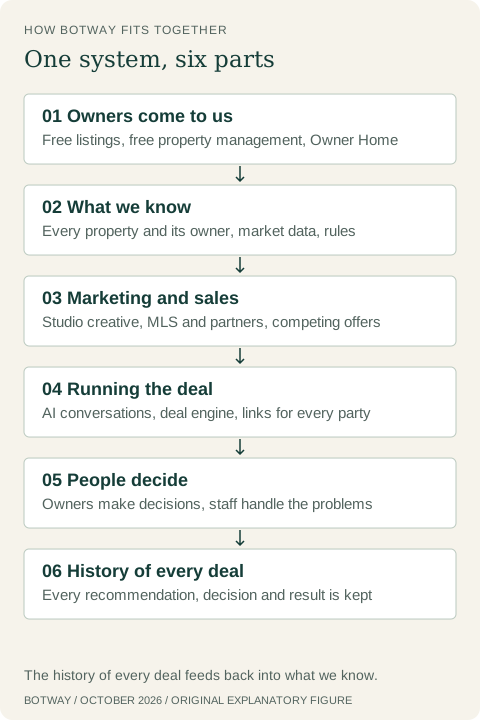
Figure 2. How Botway fits together. Every recommendation, decision and result is saved, and that history shapes the next price, the next campaign and the next deal.
7.1 Design rules
Most of these rules come from things I watched go wrong.
A deal is a structured record, not an inbox. Every listing, showing, application, offer, lease and closing has an owner, a deadline, the documents it needs and a next step. We keep track of that even when someone outside Botway does the work.
People see only what needs them. Staff see the deals that need attention, like a best-and-final deadline in the next hour. And attention doesn't fade. The 200th inquiry on a listing gets the same answer as the first.
The owner decides, with everything in front of them. We give direct advice in dollars, show every offer and complete application, and never hold back a higher offer because a lower one would be easier to close.
We never claim what we can't know. A tenant saying rent was paid, a check of the receipt, and the landlord confirming the money arrived are three different facts, and only the last one shows as paid.
What an owner tells us in confidence stays with them. An owner's lowest acceptable price is never shown to a co-owner or the other side and never put into an AI prompt.
Everyone in the deal can act. Supers, vendors and buyers' attorneys rarely have accounts, so each gets a private link showing only their part.
7.2 What does the work
Conversations. Our AI, built on language models, answers renters, buyers, brokers and owners by email and text, using the facts on file. When it doesn't know something, it asks the person who does, keeps track of the promise and comes back with the answer. Questions for an owner are gathered into one message instead of a stream of interruptions.
Analysis. Other AI tools read offers and applications, compare terms, check how a listing is performing and prepare recommendations. They follow a short set of explicit rules covering the broker's duties, when to hand off to a person, and fair housing.
The deal engine. When an applicant is approved or an offer is accepted, Botway opens the deal with every step, deadline, document and responsible person. Routine steps move forward on their own. When the owner has already approved a lease form for the building, the lease goes out for signature the moment they approve the applicant. The owner's screen shows the decisions waiting for them. The staff screen shows the problems.
7.3 A sale inside Botway
This example is illustrative. Every step in it is built into our software.
An owner in Astoria, Queens tells us she's thinking about selling her two-family house. Botway pulls the deed, the purchase price and the open mortgage, asks for her target price, her date and, if she wants to share it, her lowest acceptable price, and tells her that last number stays private. It proposes an asking price from recent nearby sales and shows the comparables and the math. She approves, and the listing goes out the same day. After 14 days Botway compares the listing's activity with what's normal for two-family houses in Astoria and finds it on track.
Then three offers arrive over a weekend from three brokers in three formats. The highest depends on 70% financing and on the buyers selling their own home. The second is $25,000 lower, all cash, closing in 30 days. The third comes with a pre-approval letter from an unfamiliar lender. Botway reads each offer term by term, checks the proof of funds, asks for a missing bank statement and works out what she actually nets from each after transfer taxes and fees. It shows her the offers together, names the risk in each and flags the home-sale condition as the leading offer's most likely point of failure. Because the nets are within 3% of each other, it recommends a best-and-final round for every buyer, with 48 hours to respond. She approves, and every buyer hears at once.
After she accepts, the deal engine lays out every step to closing. When the buyer's lender misses the appraisal date, staff see one problem, and her screen tells her what's late, who owes it and that she doesn't need to do anything. Our fee at closing is 1%, or $10,000 on a $1,000,000 sale, against $30,000 at a 3% listing fee. The full history of the deal becomes part of what we know about selling two-family houses in Astoria.
8. How the system learns
Kenneth Arrow observed that productivity rises with experience, because learning comes from doing [44]. In a traditional brokerage that learning belongs to individual agents and lives, if anywhere, in their email. When they leave, it leaves.
We keep it. Each step of a deal is saved together with the reason it happened, and each recommendation is linked to the goal it served, the evidence behind it, the owner's decision, what happened next and the result. Traditional agents leave behind folders of email. We leave behind structured brokerage knowledge. This is how Claim 4 works, and it turns tacit knowledge, in Polanyi's sense, into written procedure [5].
People stepping in play a special role. Every time someone edits or rejects something Botway prepared, we record what changed and why. Some reasons reveal a missing fact, some a weak rule, and some a decision that should stay with a person. Heavy human review early on is an investment in doing more automatically later, as well as protection for the deal at hand.
That record also decides how much Botway does on its own. SAE International defines levels of driving automation so that "self-driving" is a matter of degree [45]. We apply the same idea, but set the level for each kind of action and each audience, not for the company as a whole.
| Level | What Botway does | Examples |
|---|---|---|
| Inform | Reports what happened | A tour booked, an offer received, an appraisal late |
| Advise | Recommends a specific action and explains why | A best-and-final round, a price cut of a named amount |
| Prepare | Builds the action for a person to approve | A counteroffer, a change in list price |
| Act | Does it and records it | Answering an inquiry, sending a tour link, sending an approved lease |
Figure 3. How much Botway does on its own, by kind of action. Each kind moves up or down based on its own record.
Refusal is not one of the levels. It applies at every level. Botway refuses anything that would steer an applicant or misstate a fact and hands it to a person, no matter how well everything else is going.
When people approve a kind of action again and again without changes, it can move up a level. When they keep correcting it, it moves down. A pricing recommendation to a seller may stay at "advise" forever. Moving up is a decision we make with the evidence in front of us, never something the system grants itself.
9. Scale and competitive advantage
9.1 How many clients one team can serve
The right measure is human minutes per completed deal. For any kind of deal, those minutes have three parts:
m = r + x × t + s
Here r is the routine human time left in every deal, such as physical work and the conversations an owner wants to have with a person. x is the expected number of problems per deal and t is the average time each one takes. s is the oversight each deal needs. We divide by completed deals, so time spent on deals that fall apart is charged to the ones that close. A team's capacity is its available minutes divided by m.
In a traditional brokerage r is large, because a person does nearly every step. We are built to shrink r to the work only a person can do, to cut x as the system learns to prevent recurring problems, and to keep s small by showing people only what needs them. The math isn't simply proportional. As routine cases are automated, the problems left may be harder, so t can rise as x falls, and oversight and relationships never disappear. We don't assume m falls. It is the thing we have to measure. As an illustration only, if a traditional lease takes ten hours of human time and a Botway lease takes two, the same team can complete about five times as many leases, as long as the remaining problems don't get correspondingly worse. Those numbers are hypothetical. The number Claim 1 requires us to measure, by kind of deal and over time, is m itself.
9.2 Why the parts belong together
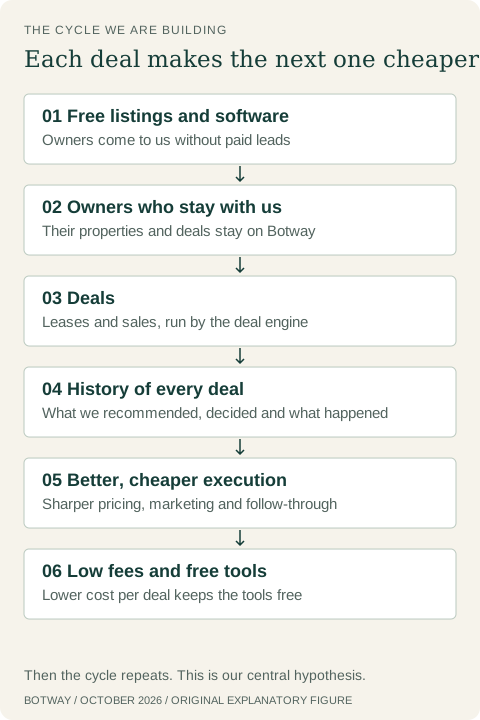
Figure 4. The cycle we are building. Each turn is meant to lower the cost of the next deal. This is our central hypothesis, and we are now testing it with real clients.
Paul Milgrom and John Roberts showed that when activities strengthen each other, improving one raises the payoff from the others, so it pays to do them together [46]. Our model assumes Botway's parts work this way. Free tools bring owners into regular use. Those owners bring property data and deals. Deals build the history the system learns from. That history improves pricing, marketing and execution, which lowers our cost and keeps the tools free. If that holds, every part is worth more because the others run inside the same company on the same information. Whether it holds is what the measures in section 11 will show.
9.3 Why Botway is a brokerage
Two other kinds of company can chase the same opportunity. A software company can sell tools to brokers, and a traditional brokerage can adopt AI. Each has real strengths, including focus, scale, existing customers and experienced people. David Teece showed that the rewards from a new technology tend to go to whoever controls the other assets needed to bring it to market [47]. That doesn't mean the alternatives must lose. It explains what our structure is meant to give us.
Our advantage rests on three things. First, we run the brokerage and build the software, so when something keeps going wrong in a deal we can fix both the process and the code. Second, we hold the license and the client relationship, so we act for the owner ourselves rather than equipping someone else to act. Third, we see what happened after every recommendation and keep that record, where it improves the next decision.
A software vendor usually sees less of the outcome, works through its customers and is often paid per seat. A traditional brokerage that adopts AI makes each agent faster, while relationships and records stay largely with individual agents and the commission split still shapes the price. Both can close some of that gap. Our bet is that a company built around all three from the start will compound them faster.
9.4 Cloning
AI is making software cheap to copy. Open-source tools now let AI coding agents study an existing app and build a version of it [48]. Menlo Ventures proposes a "clone test" for AI companies. If you copied the founding team and the code today and gave the copy the latest models, why wouldn't the copy win? Its answer is data that compounds from real work, feedback from customers, network effects, and regulatory and institutional trust [13].
We assume our screens and workflows will be copied. The same force works in our favor. Software that incumbents sell by the unit, property management above all, can now be built by a small team for a fraction of what it once cost. That is part of why we can give it away. Where software alone was the product, its price is heading toward zero.
A copy of Botway would get the code and nothing else. It would not have the license or the owners already running their properties with us. It would not have our record of properties and owners, the demand attached to our listings, or the history linking our recommendations to their results. Each can be rebuilt, but only with time and real deals.
Incumbents are moving too. Yardi, MRI and AppFolio have each announced AI that does work, and AppFolio describes agents running across leasing, accounting and resident operations [49] [50] [51]. So our advantage can't rest on using AI agents. It rests on the combination: owners who come to us directly through free tools, a licensed brokerage responsible for results, lasting knowledge of properties and owners, our own marketing, and a history that links decisions to outcomes. Each piece can be copied. Assembling all of them, with the history they produce, takes time. Incumbents can answer with separate products, partnerships, acquisitions or subsidies. Our edge, if it holds, is having built the whole combination from the start, with no commission or per-unit revenue to protect.
10. Rules, responsibility and trust
Our rules are how an owner hands authority to Botway, not an obstacle to automation. The owner sets a goal and its limits. Every action Botway can take is classified in advance. Botway may do it, must prepare it for approval, or must refuse and hand it to a person. An approval covers that exact action, so if the price, recipient or document changes, it no longer applies. Inside those limits we move fast. Outside them we stop.
Licensing and accountability. AI doesn't hold a license. Every Botway deal has a responsible licensed broker, written agreements and the required disclosures. The software supports those duties. It doesn't replace them.
Fair housing. Automation can speed up discrimination as easily as service. In 2024 the Department of Housing and Urban Development issued guidance that the Fair Housing Act applies to tenant screening and housing ads run by algorithms [52]. Botway asks every applicant the same questions and applies the same written criteria. It gives the owner documented facts and never characterizes or ranks applicants. It never considers a buyer's occupation, which New York City protects, and measures financing by the lender's documents. Source of income, including housing vouchers, is protected in New York and Connecticut [53] [54], and we represent voucher holders at no cost.
Pricing data. In 2024 the Department of Justice sued RealPage, alleging that its software let landlords coordinate rents using each other's private data [55]. New York's General Business Law section 340-b addresses rent pricing and recommendations that rely on information pooled from multiple independent owners or managers [56]. That bears directly on us, because our own listing history combines information from many independent owners, and calling it ours doesn't settle the question. Our position is that rent recommendations should rest on public records, public market data and what an owner tells us about their own property. We never share one owner's private terms with another, and any use of pooled listing history in rent recommendations needs legal review against the statute and federal antitrust law before release.
Money. We never hold rent, deposits or sale proceeds. We record payments that pass between the parties and send receipts, which keeps us out of the path of funds and its risks.
Physical work. Some work will always be physical, and that is reasonable. Someone takes the photographs, installs a lockbox and copies the keys, and sometimes I talk with a buyer myself. Our goal is software that runs the whole transaction, but we don't have to reach that goal to help owners enormously. Every step software takes over is a step that no longer needs a broker in the room. Where a step must be physical, Botway schedules it, assigns it to a named person through a private link and tracks it to completion.
Showings are the clearest example of a physical step that no longer needs a broker in the room, as section 6.4 explains.
Mistakes and bad data. AI makes mistakes, and public records are incomplete. So AI is never the record of a deal. Deadlines, permissions and documents live in structured records governed by rules, every fact keeps its source, conflicts are shown instead of quietly resolved, and anything unknown is marked unknown.
11. What is built, what comes next, and who judges it
If these claims hold, the brokerage changes shape. Coase's framework predicts that work moves inside a firm when doing it there gets cheaper [4]. Buyers and renters from listing portals, creative work from agencies, transaction coordination from contractors and records from software vendors can all come in-house once software coordinates them cheaply. The company gets broader in what it does and smaller in staff relative to its volume. Experienced brokers stop relaying information. They set goals with owners, make the hard calls, handle problems and correct the system, applying their judgment across far more deals than they could run themselves. Clients pay a price closer to what the work actually costs, get attention that lasts the whole listing, and see the same record we see. And a company whose cost to serve one more client is low can serve voucher holders and owners of a single unit on the same terms as large portfolios.
What we have built. The software for each part of this paper exists today: free listings and syndication, free property management, Owner Home, the record of properties and owners, 14-day pricing reviews, Studio marketing, competing offers with best and final rounds, AI conversations, offer and application review, self-guided showings, the deal engine, the rules for what Botway may do on its own, and the saved history of every recommendation and result.
What we have already done, and what comes next. We have already completed rental transactions, and Botway already provides automated, identity-verified entry through clients' own building security systems. Next is a complete sale run the same way, from pricing to closing, then a year of property management run on the software through rent, repairs, renewals and month-end books, and live ad spending measured against real tours and applications. Along the way we will keep measuring the human minutes per completed deal, how they fall with experience, how often free owners hire us, and whether our recorded results produce better prices and faster deals.
Who judges it. In the end our clients will. The test of an autonomous brokerage is not whether the software works in a demonstration. It is whether owners, renters and buyers choose to use us, come back and send others. We will track that alongside response times, what owners keep compared with traditional fees, why people stepped in and every complaint.
12. Conclusion
I began with a thought experiment: how to build a brokerage on the assumption that software will soon do most of the work. My answer is not a cheaper brokerage with AI bolted on. It is a company whose capacity grows through software, whose judgment improves with every deal, and whose relationship with an owner lasts as long as the owner holds the property.
In that company, free tools start the relationship, the record of each property keeps its context, our marketing wins the buyers' and renters' attention, competition brings out their best offers, AI and the deal engine do the work, clear rules decide what can happen without a person, and the history of every deal makes the next one better. Together they make it possible to serve enormous numbers of owners with constant attention, without growing headcount in step.
Real estate spent decades digitizing its records while paying people to coordinate everything else. Software can now do that coordination and deliver the outcome itself. What remains is what always mattered most in brokerage: sound judgment, exercised for the owner, by a company accountable for the result.
References
- Fortune. NAR settles lawsuits, and real estate commissions are under threat. March 15th, 2024. https://fortune.com/2024/03/15/nar-settles-lawsuits-real-estate-commissions-threat/
- National Association of Realtors, in the news. The U.S. posts its slowest annual sales of homes since 1995. NPR, January 24th, 2025. https://www.nar.realtor/newsroom/in-the-news/the-u-s-posts-its-slowest-annual-sales-of-homes-since-1995-npr-all-things-considered
- National Association of Realtors. NAR membership remains above forecast. June 5th, 2025. https://www.nar.realtor/news/real-estate-news/nar-membership-remains-above-forecast
- Ronald H. Coase. The Nature of the Firm. Economica 4, no. 16 (1937): 386-405. https://doi.org/10.1111/j.1468-0335.1937.tb00002.x
- Michael Polanyi. The Tacit Dimension. Doubleday, 1966. Reissued by University of Chicago Press, 2009. https://press.uchicago.edu/ucp/books/book/chicago/T/bo6035368.html
- Chang-Tai Hsieh and Enrico Moretti. Can Free Entry Be Inefficient? Fixed Commissions and Social Waste in the Real Estate Industry. Journal of Political Economy 111, no. 5 (2003): 1076-1122. https://www.nber.org/papers/w9208
- William J. Baumol. Macroeconomics of Unbalanced Growth: The Anatomy of Urban Crisis. American Economic Review 57, no. 3 (1967): 415-426. https://www.jstor.org/stable/1812111
- Steven D. Levitt and Chad Syverson. Market Distortions When Agents Are Better Informed: The Value of Information in Real Estate Transactions. Review of Economics and Statistics 90, no. 4 (2008): 599-611. https://www.nber.org/papers/w11053
- George A. Akerlof. The Market for "Lemons": Quality Uncertainty and the Market Mechanism. Quarterly Journal of Economics 84, no. 3 (1970): 488-500. https://doi.org/10.2307/1879431
- CNBC. Zillow says it's closing home-buying business and cutting 25% of workforce. November 2nd, 2021. https://www.cnbc.com/2021/11/02/zillow-shares-plunge-after-announcing-it-will-close-home-buying-business.html
- Richard Susskind and Daniel Susskind. The Future of the Professions: How Technology Will Transform the Work of Human Experts. Oxford University Press, 2015. https://www.danielsusskind.com/the-future-of-the-professions
- Foundation Capital. AI leads a service as software paradigm shift. Checked October 22nd, 2026. https://foundationcapital.com/ai-service-as-software/
- JP Sanday, Croom Beatty, Sam Borja and Sabrina Lu. Software Finally Gets to Work: The Opportunity in Vertical AI. Menlo Ventures, April 7th, 2026. https://menlovc.com/perspective/software-finally-gets-to-work-the-opportunity-in-vertical-ai/
- Anthropic. Building effective agents. December 19th, 2024. https://www.anthropic.com/research/building-effective-agents
- Stanford Institute for Human-Centered AI. The 2025 AI Index Report. 2025. https://hai.stanford.edu/ai-index/2025-ai-index-report
- Guido Appenzeller. Welcome to LLMflation: LLM inference cost is going down fast. Andreessen Horowitz, November 12th, 2024. https://a16z.com/llmflation-llm-inference-cost/
- METR. Measuring AI Ability to Complete Long Tasks. March 19th, 2025. https://metr.org/blog/2025-03-19-measuring-ai-ability-to-complete-long-tasks/
- Erik Brynjolfsson, Danielle Li and Lindsey R. Raymond. Generative AI at Work. Quarterly Journal of Economics 140, no. 2 (2025): 889-942. https://doi.org/10.1093/qje/qjae044
- ShowMojo and Tenant Turner. Renters Embrace AI: AI Leasing Agents Handle Nearly 100% of Prospective Tenant Conversations Without Human Involvement. September 25th, 2026. https://www.globenewswire.com/news-release/2026/09/25/3369282/0/en/renters-embrace-ai-ai-leasing-agents-from-showmojo-and-tenant-turner-handle-nearly-100-of-prospective-tenant-conversations-without-human-involvement.html
- National Association of Realtors. NAR Settlement FAQs. Checked October 22nd, 2026. https://www.nar.realtor/the-facts/nar-settlement-faqs
- New York City Department of Consumer and Worker Protection. The FARE Act Is Now in Effect. June 11th, 2025. https://www.nyc.gov/site/dca/news/018-25/dcwp-the-fare-act-now-effect
- National Association of Realtors. NAR 2025 Profile of Home Buyers and Sellers reveals market extremes. November 4th, 2025. https://www.nar.realtor/news/real-estate-news/nar-2025-profile-of-home-buyers-sellers-reveals-market-extremes
- National Association of Realtors. Realtors Embrace AI, Digital Tools to Enhance Client Service, NAR Survey Finds. September 18th, 2025. https://www.nar.realtor/newsroom/realtors-embrace-ai-digital-tools-to-enhance-client-service-nar-survey-finds
- Brooklee Han. The $60 million question: Have agent commissions changed since the settlement? HousingWire, August 8th, 2025. https://www.housingwire.com/articles/the-60-million-question-have-agent-commissions-changed-since-the-settlement/
- New York Department of State. Become a Real Estate Salesperson. Checked October 22nd, 2026. https://dos.ny.gov/real-estate-agent
- Connecticut Department of Consumer Protection. Real Estate Salesperson - Initial/Exam. Checked October 22nd, 2026. https://portal.ct.gov/dcp/license-services-division/all-license-applications/real-estate-salesperson---initialexam
- Buildium. Pricing. Checked October 15th, 2026. https://www.buildium.com/pricing/
- DoorLoop. Pricing. Checked October 15th, 2026. https://www.doorloop.com/pricing
- Jean-Charles Rochet and Jean Tirole. Platform Competition in Two-Sided Markets. Journal of the European Economic Association 1, no. 4 (2003): 990-1029. https://doi.org/10.1162/154247603322493212
- New York City Department of Finance. ACRIS: Automated City Register Information System. Checked October 22nd, 2026. https://www.nyc.gov/site/finance/property/acris.page
- The Preiss Company. The Preiss Company Expands Self-Guided Tours with Tour24. Press release, September 3rd, 2024. https://www.silicon.co.uk/press-release/the-preiss-company-expands-self-guided-tours-with-tour24
- Hemlane. Showings to Fill a Vacancy: Benchmark Data. July 30th, 2026. https://hemlane.com/resources/showings-to-fill-a-vacancy-benchmark-data/
- Debbi Conrad. Long Island Steering Investigation. Wisconsin Real Estate Magazine, February 1st, 2020, reporting Newsday's Long Island Divided investigation. https://wra.org/WREM/Feb20/Steering
- New York State Attorney General. AG James Investigates Housing Discrimination On Long Island. November 19th, 2019. https://ag.ny.gov/press-release/2019/ag-james-investigates-housing-discrimination-long-island
- Federal Trade Commission. Rental Listing Scams. Checked October 22nd, 2026. https://consumer.ftc.gov/articles/rental-listing-scams
- SmartRent. SmartRent Celebrates One Millionth Self-Guided Tour. October 17th, 2024. https://investors.smartrent.com/news/news-details/2024/SmartRent-Celebrates-One-Millionth-Self-Guided-Tour/default.aspx
- Security Systems News. DOOR to bring self-guided touring and leasing to services in deal with block.a. September 6th, 2024. https://www.securitysystemsnews.com/article/door-to-bring-self-guided-touring-and-leasing-to-services-in-deal-with-block-a
- Brooklee Han. NAR clarifies details on buyer broker agreements. HousingWire, April 30th, 2024. https://www.housingwire.com/articles/nar-clarifies-details-on-buyer-broker-agreements/
- Christine Serlin. Virtual, Self-Guided, and In-Person Tours Remain Integral for Prospective Renters. Multifamily Executive, April 1st, 2024. https://www.multifamilyexecutive.com/property-management/apartment-trends/virtual-self-guided-and-in-person-tours-remain-integral-for-prospective-renters_o
- Jeremy Bulow and Paul Klemperer. Auctions Versus Negotiations. American Economic Review 86, no. 1 (1996): 180-194. https://ideas.repec.org/a/aea/aecrev/v86y1996i1p180-94.html
- The Royal Swedish Academy of Sciences. The Prize in Economic Sciences 2020: Paul R. Milgrom and Robert B. Wilson, for improvements to auction theory and inventions of new auction formats. October 12th, 2020. https://www.nobelprize.org/prizes/economic-sciences/2020/press-release/
- Paul R. Milgrom and Robert J. Weber. A Theory of Auctions and Competitive Bidding. Econometrica 50, no. 5 (1982): 1089-1122. https://www.econometricsociety.org/publications/econometrica/1982/09/01/theory-auctions-and-competitive-bidding
- The Royal Swedish Academy of Sciences. The Prize in Economic Sciences 2002: Daniel Kahneman, for having integrated insights from psychological research into economic science. 2002. https://www.kva.se/en/news/ekonomipriset-2002-2/
- Kenneth J. Arrow. The Economic Implications of Learning by Doing. Review of Economic Studies 29, no. 3 (1962): 155-173. https://doi.org/10.2307/2295952
- SAE International. J3016: Taxonomy and Definitions for Terms Related to Driving Automation Systems for On-Road Motor Vehicles. April 2021. https://www.sae.org/standards/content/j3016_202104/
- Paul Milgrom and John Roberts. The Economics of Modern Manufacturing: Technology, Strategy, and Organization. American Economic Review 80, no. 3 (1990): 511-528. https://www.jstor.org/stable/2006681
- David J. Teece. Profiting from Technological Innovation: Implications for Integration, Collaboration, Licensing and Public Policy. Research Policy 15, no. 6 (1986): 285-305. https://doi.org/10.1016/0048-7333(86)90027-2
- morluto. REA: Reverse engineer anything with agents. GitHub repository. Checked October 22nd, 2026. https://github.com/morluto/rea
- Yardi. Yardi Unveils Virtuoso Enterprise. October 5th, 2026. https://www.yardi.com/news/press-releases/yardi-unveils-virtuoso-enterprise/
- MRI Software. MRI Software Launches Agora Intelligence and Agora Orchestrator. June 25th, 2026. https://www.mrisoftware.com/news/mri-software-launches-agora-intelligence-and-agora-orchestrator-delivering-ai-powered-recommendations-and-workflow-execution-for-real-estate/
- AppFolio. AppFolio Deepens Agentic AI Across Leasing, Accounting, and Resident Operations. June 16th, 2026. https://www.appfolio.com/newsroom/appfolio-deepens-agentic-ai-across-leasing-accounting-and-resident-operations
- U.S. Department of Housing and Urban Development. HUD Issues Fair Housing Act Guidance on Applications of Artificial Intelligence. May 2nd, 2024. https://archives.hud.gov/news/2024/pr24-098.cfm
- New York State Division of Human Rights. Source of Income Discrimination. Checked October 22nd, 2026. https://dhr.ny.gov/source-income-discrimination
- Connecticut Commission on Human Rights and Opportunities. How Do You Recognize Discrimination? Checked October 22nd, 2026. https://portal.ct.gov/chro/home/complaint-process/fair-housing/how-do-you-recognize-discrimination
- U.S. Department of Justice. Justice Department Sues RealPage for Algorithmic Pricing Scheme that Harms Millions of American Renters. August 23rd, 2024. https://www.justice.gov/archives/opa/pr/justice-department-sues-realpage-algorithmic-pricing-scheme-harms-millions-american-renters
- New York General Business Law section 340-b. Checked October 22nd, 2026. https://www.nysenate.gov/legislation/laws/GBS/340-B
Questions about the paper? Contact Botway.